Contents
Introduction
Modern applications generate massive amounts of data every second. But storing data in a database isn’t enough – the real value comes from making that data available across systems in real-time.
Whether it’s analytics dashboards, machine learning models, or business intelligence tools, organizations need a reliable way to move data from transactional databases to other systems.
This is where Change Data Capture (CDC) and Debezium come in.
Why Move Data Out of Databases?
Every application stores its data in a database like PostgreSQL using:
- Inserts
- Updates
- Deletes
This data is critical for:
- Analytics & reporting
- Machine learning & AI (RAG systems)
- Business decision-making
- Backend processing systems
The Challenge
How do you efficiently move this data to other systems?
You need a solution that is:
- Easy to build
- Provides real-time data
- Easy to deploy
- Handles schema changes automatically
Traditional Approaches (And Their Problems)
1. SQL Queries (Batch Jobs)
- Run queries periodically (e.g., 4 times a day)
- Export data to files
Problems:
- Not real-time
- High load on database
- Manual deployment
- No schema change handling
2. Database Backups
- Restore backups to another system
- Query data from there
Problems:
- Delayed data (not fresh)
- Complex setup
- Schema changes unmanaged
3. Reading Write-Ahead Logs (WAL)
- Directly read database logs
Problems:
- Complex (binary logs)
- Hard to maintain
- Deployment challenges
The Best Approach: Change Data Capture (CDC)
Change Data Capture (CDC) tracks changes in your database in real-time.
It captures:
- Insert → Create
- Update → Before & After
- Delete → Removed record
Instead of polling, CDC streams changes as they happen.
What is Debezium?
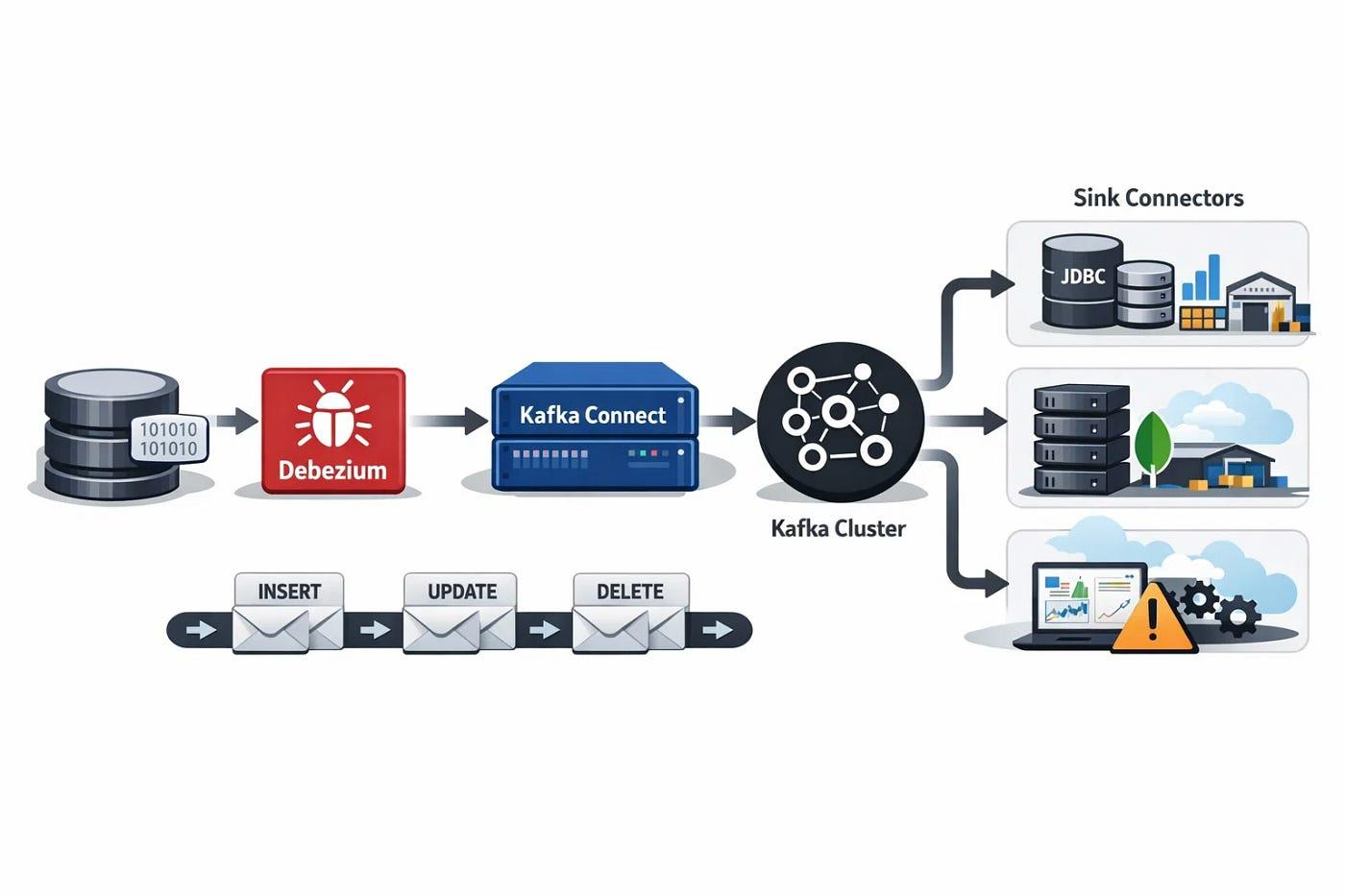
Debezium is an open-source CDC platform that:
- Captures database changes in real-time
- Streams them to systems like Kafka
- Handles schema changes automatically
It runs on Kafka Connect, a distributed framework for data integration.
How Debezium Works
Step-by-step flow:
- Database (PostgreSQL) writes changes to Write-Ahead Log (WAL)
- Debezium reads WAL continuously
- Converts changes into structured events
- Sends them to Kafka topics
Example of CDC Events
Insert (Create)
{
  "op": "c",
  "after": { "id": 1, "name": "John" }
}
Update
{
  "op": "u",
  "before": { "name": "John" },
  "after": { "name": "John Doe" }
}
Delete
{
  "op": "d",
  "before": { "id": 1 }
}
Handling Schema Changes
Schema changes are one of the hardest problems in data systems.
Without Debezium:
- Every consumer must handle schema changes
With Debezium + Schema Registry:
- Centralized schema management
- Automatic validation
- Prevents breaking changes
Much safer and scalable approach
Key Components
PostgreSQL
- Source database
- Stores transactional data
Debezium
- Reads database changes
- Converts them into events
Kafka
- Streams data to other systems
Schema Registry
- Manages schema evolution
Security Features
Debezium supports:
- Data masking (hide sensitive fields)
- Field-level encryption
- Secure connections (SSL)
Ensures compliance and data protection
Scalability Considerations
Key concept: Slots & Publications
- Slot → Tracks WAL position
- Publication → Defines tables to monitor
Important rule:
- One table → One thread (task)
Scaling options:
- Increase CPU/memory
- Partition tables (horizontal/vertical)
- Use multiple connectors
Advanced Features (Debezium V2)
- Faster performance
- Supports newer PostgreSQL versions
- Incremental snapshots (huge for large tables)
- Regex-based table selection
- Better topic/schema naming
Snapshot vs Real-Time
Snapshot:
- Reads all existing data initially
Incremental Snapshot:
- Streams new data immediately
- Loads historical data in background
Faster startup and better performance
Real-World Use Cases
- Real-time analytics dashboards
- Machine learning pipelines
- Data synchronization across services
- E-commerce event tracking
- Financial transaction monitoring
Final Thoughts
Moving data from transactional systems to analytics and other services is a critical challenge.
Traditional methods are slow, complex, and unreliable.
Debezium + CDC provides a modern, scalable, real-time solution.
If you’re building:
- Data pipelines
- Event-driven systems
- Real-time applications
Then learning CDC is a must.
Conclusion
Debezium simplifies one of the hardest problems in modern data systems – reliable, real-time data movement.
Instead of building complex pipelines from scratch, you can:
- Capture changes automatically
- Stream data instantly
- Scale effortlessly