The internet began as a communication system.
It evolved into a global information network connecting:
- people
- businesses
- institutions
- economies
- software systems
Then cloud computing transformed the internet into a planetary execution layer capable of:
- scalable computation
- distributed storage
- real-time orchestration
- hyperscale applications
Artificial intelligence accelerated this transition further.
But a deeper architectural shift is now underway.
The internet is evolving beyond:
Contents
information infrastructure
and beyond:
cloud infrastructure
toward:
Cognitive Civilization Infrastructure.
This may become one of the most important infrastructure transitions of the 21st century.
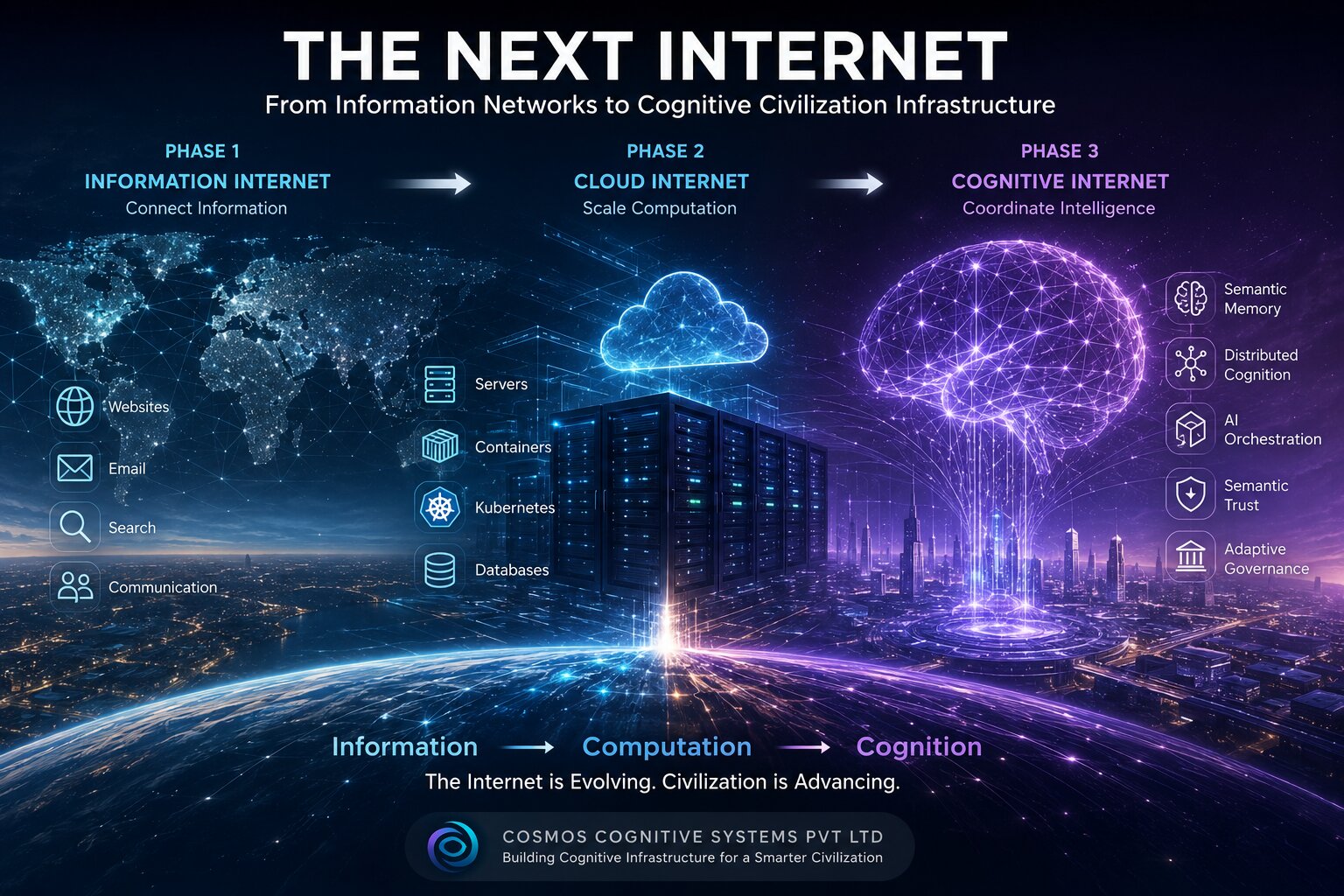
Phase 1 — The Information Internet
The first era of the internet optimized:
information exchange.
Core technologies included:
- websites
- HTTP
- DNS
- search engines
- static applications
The internet’s primary function was:
publish
→ access
→ communicate
This era connected humanity through:
- digital communication
- online publishing
- internet commerce
- searchable information
The internet became:
humanity’s information layer.
Phase 2 — The Cloud Internet
As software systems became more complex, infrastructure evolved into:
cloud computing.
Cloud infrastructure optimized:
- scalability
- elasticity
- distributed execution
- infrastructure automation
Core technologies included:
- virtualization
- containers
- Kubernetes
- distributed databases
- event-driven systems
- hyperscale data centers
The internet evolved into:
programmable infrastructure.
Its operational model became:
deploy
→ scale
→ automate
This phase enabled:
- SaaS platforms
- streaming ecosystems
- mobile applications
- AI platforms
- real-time digital services
Cloud computing became:
the operational substrate of the digital economy.
Phase 3 — The Cognitive Internet
A new layer is now emerging.
Modern systems are increasingly expected not only to:
- store information
- process requests
- automate workflows
but also to:
- reason
- predict
- coordinate
- optimize
- adapt
- operate autonomously
This creates the rise of:
Cognitive Infrastructure.
Core primitives now include:
- semantic memory
- distributed cognition systems
- vector databases
- world models
- AI orchestration
- adaptive governance
- semantic trust systems
- autonomous coordination engines
The internet’s operational model evolves into:
observe
→ understand
→ reason
→ coordinate
→ evolve
The internet is becoming:
cognition-native.
The Limits of Today’s AI Systems
Most current AI systems remain:
- stateless
- isolated
- prompt-driven
- non-persistent
They can generate responses but lack:
- durable memory
- semantic continuity
- contextual persistence
- institutional reasoning
- adaptive governance
Civilization-scale cognition cannot operate through disconnected prompts alone.
Future cognitive infrastructure requires:
- persistent semantic memory
- distributed reasoning
- adaptive orchestration
- governance-aware execution
- semantic synchronization
- recursive coordination systems
The challenge is no longer simply:
Can machines generate intelligence?The challenge becomes:
Can civilization coordinate intelligence?The Rise of Semantic Coordination Infrastructure
The next generation internet may not primarily transport:
- webpages
- files
- APIs
- media streams
It may increasingly transport:
- semantic state
- reasoning lineage
- trust graphs
- world models
- cognition flows
- autonomous coordination signals
This creates:
Semantic Coordination Infrastructure.
In this model:
- reasoning becomes distributed
- memory becomes persistent
- coordination becomes adaptive
- governance becomes executable
- cognition becomes composable
The internet evolves from:
a network of informationinto:
a network of cognitionWhy Infrastructure Economics Must Change
Traditional cloud infrastructure scales through:
- more servers
- more GPUs
- more storage
- more energy
- more replication
But civilization-scale cognition cannot scale linearly forever.
The current trajectory creates:
- exploding infrastructure cost
- rising energy consumption
- thermal bottlenecks
- centralized compute concentration
- infrastructure fragility
Future cognitive systems must optimize:
cognition density.
This introduces new infrastructure principles:
- semantic compression
- local cognition
- entropy-aware execution
- adaptive synchronization
- distributed reasoning
- hierarchical consensus
The goal becomes:
max(Cognitive Throughput×Semantic ValueInfrastructure Cost×Entropy)\max\left(\frac{Cognitive\ Throughput \times Semantic\ Value}{Infrastructure\ Cost \times Entropy}\right)max(Infrastructure Cost×EntropyCognitive Throughput×Semantic Value)
This fundamentally changes infrastructure economics.
Civilization Runtime Systems
Future infrastructure systems may increasingly behave less like:
- isolated applications
and more like:
persistent civilization runtime systems.
These systems continuously:
- observe environments
- maintain memory
- coordinate intelligence
- optimize resources
- forecast outcomes
- govern execution
- adapt dynamically
This creates an entirely new infrastructure category:
Civilization Runtime Infrastructure.
The Most Important Transition
The internet connected:
computers.
Cloud computing connected:
infrastructure.
Cognitive systems are beginning to connect:
reasoning itself.
That is a much larger architectural transition.
Because the true bottleneck of civilization has never been computation alone.
It has been:
- coordination
- trust
- governance
- memory
- collective intelligence
The infrastructure systems capable of coordinating cognition at planetary scale may ultimately define the next era of civilization itself.
Final Thesis
The next internet may not primarily function as:
- an information network
or: - a cloud execution layer
It may evolve into:
a planetary cognitive coordination system.
A system capable of:
- persistent reasoning
- semantic continuity
- adaptive governance
- distributed intelligence
- autonomous coordination
across institutions, infrastructures, and societies.
The organizations building the architecture for this transition may shape the foundational infrastructure layer of the next century.