Artificial intelligence is entering a new architectural era.
For the past several years, most AI systems have been designed as:
- assistants
- copilots
- prompt orchestration layers
- automation tools
- workflow engines
- chatbot interfaces
These systems generate responses.
They automate tasks.
They accelerate productivity.
But they still suffer from a foundational limitation:
they do not preserve cognition across time.
Most AI systems today are fundamentally stateless.
They reason momentarily.
Then forget.
This is beginning to change.
A new category of infrastructure is emerging:
Contents
Cognitive Runtime Infrastructure
This is not simply another AI platform.
It represents the evolution of software infrastructure itself – from systems that execute applications to systems that execute cognition.
From Application Infrastructure to Cognition Infrastructure
Traditional infrastructure was designed to manage:
- compute
- storage
- networking
- containers
- distributed applications
- workflows
- data pipelines
Modern infrastructure systems like Kubernetes, Temporal, Kafka, Ray, and distributed consensus platforms transformed how organizations execute software.
But the next computing transition is no longer centered purely around application execution.
It is centered around:
- institutional reasoning
- memory persistence
- autonomous orchestration
- governance-aware execution
- causal decision systems
- replayable cognition
Organizations are increasingly operating in environments where decisions must be:
- explainable
- replayable
- governed
- persistent
- adaptive
- distributed
This requires a fundamentally different type of runtime.
What Is Cognitive Runtime Infrastructure?
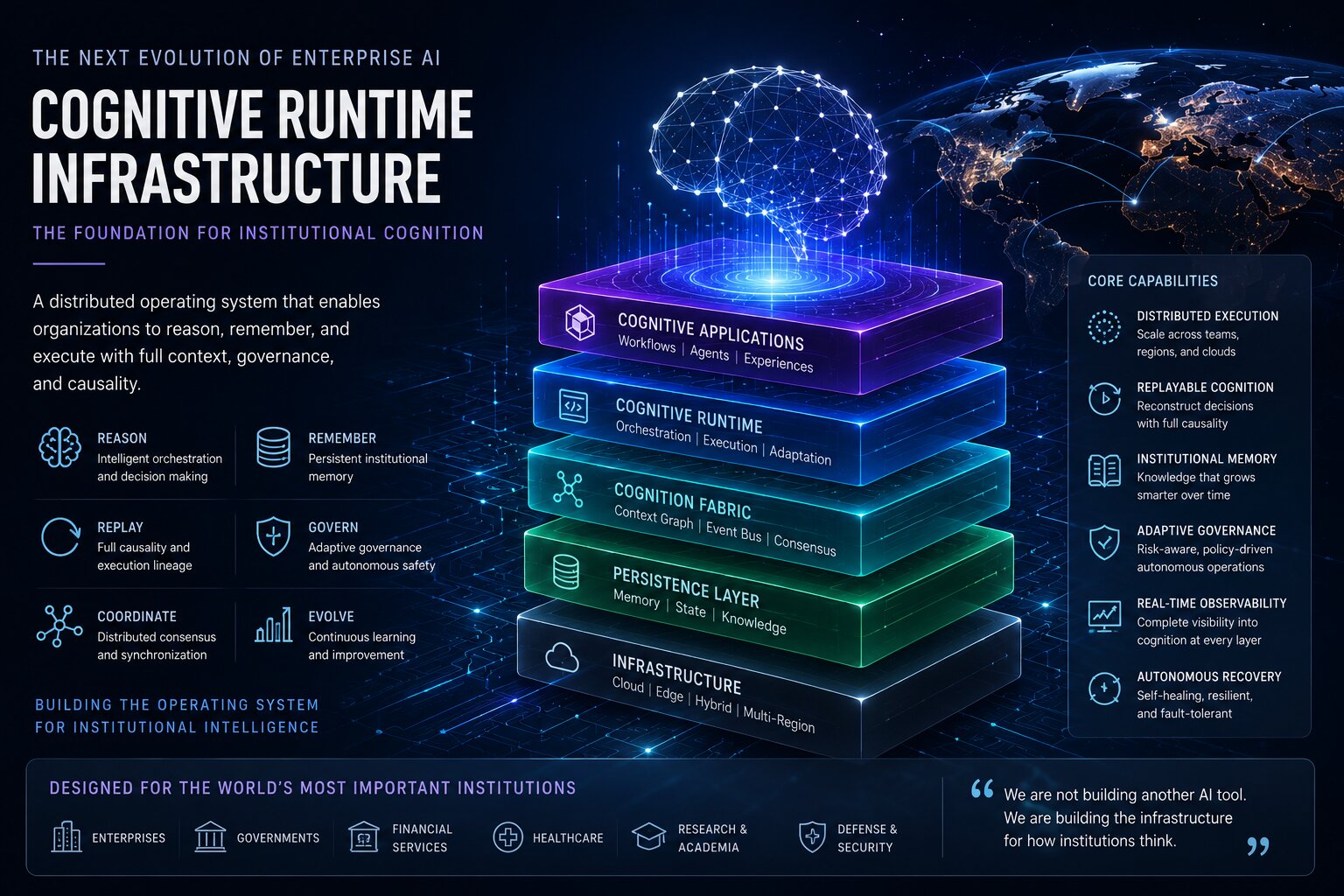
Cognitive Runtime Infrastructure is a distributed execution environment designed to orchestrate, govern, preserve, and replay institutional cognition.
In simpler terms:
it is infrastructure for how organizations think.
Just as operating systems coordinate:
- processes
- memory
- scheduling
- permissions
- persistence
Cognitive Runtime Infrastructure coordinates:
- reasoning
- orchestration
- execution lineage
- semantic memory
- governance
- autonomous recovery
- institutional decision systems
This transition is as important as the evolution from:
- monoliths → cloud infrastructure
- servers → containers
- applications → distributed systems
The next evolution is:
Distributed Cognition Infrastructure
The Core Capabilities of Cognitive Runtime Systems
Modern Cognitive Runtime Infrastructure combines several advanced architectural primitives.
1. Distributed Execution Runtime
At the core lies a distributed orchestration engine capable of:
- DAG execution
- workflow coordination
- autonomous task dispatch
- runtime scheduling
- execution state management
- distributed workload balancing
Unlike traditional automation systems, cognition runtimes manage adaptive execution rather than static workflows.
This enables systems to dynamically evolve orchestration behavior based on context, governance, memory, and runtime conditions.
2. Replayable Cognition
One of the most important breakthroughs in modern cognition systems is replayability.
Most AI systems can produce outputs.
Very few can reconstruct why those outputs were generated.
Replayable cognition changes this.
It allows institutions to:
- reconstruct reasoning paths
- replay execution history
- inspect causal chains
- audit decisions
- restore execution state
- analyze governance interventions
This creates a form of deterministic institutional intelligence.
In the future, replayable cognition may become as important to AI systems as observability became to cloud infrastructure.
3. Institutional Memory
Traditional organizations lose cognition continuously.
Knowledge disappears through:
- meetings
- disconnected systems
- employee turnover
- fragmented execution
- siloed operational data
Cognitive Runtime Infrastructure introduces persistent institutional memory.
This includes:
- semantic context graphs
- decision lineage
- execution ancestry
- governance history
- organizational reasoning patterns
- adaptive execution learning
Over time, the organization itself begins to accumulate durable cognition.
This represents a profound shift.
Institutions stop functioning merely as collections of people and tools.
They begin functioning as persistent cognitive systems.
4. Governance-Native Execution
Governance is becoming one of the defining challenges of enterprise AI.
Most AI systems treat governance as an external layer.
Cognitive Runtime Infrastructure embeds governance directly into execution.
This includes:
- execution risk scoring
- policy-aware orchestration
- autonomous intervention systems
- runtime boundary enforcement
- trust scoring
- adaptive governance evolution
In high-stakes environments such as:
- finance
- healthcare
- defense
- critical infrastructure
- sovereign systems
this becomes essential.
Governance-native cognition may ultimately become a requirement for enterprise-scale autonomous systems.
5. Consensus + Distributed Coordination
As cognition systems become distributed, they require many of the same primitives that power modern cloud infrastructure.
This includes:
- leader election
- replication
- quorum commits
- distributed durability
- federation synchronization
- inter-region coordination
In other words:
future cognition systems increasingly resemble distributed operating systems.
This is why Cognitive Runtime Infrastructure shares architectural similarities with:
- Kubernetes
- Temporal
- Kafka
- CockroachDB
- Ray
- Neo4j
- distributed consensus systems
But instead of orchestrating containers or events alone, these systems orchestrate cognition itself.
Why This Matters
The future of AI is not just about better models.
It is about persistent institutional intelligence.
Models alone cannot provide:
- long-term organizational memory
- governance durability
- replayable execution
- deterministic coordination
- distributed cognition synchronization
- operational survivability
These require infrastructure.
The next generation of enterprise systems will likely depend on cognition runtimes capable of:
- remembering across years
- coordinating across regions
- governing autonomous execution
- replaying institutional reasoning
- adapting orchestration dynamically
This is the foundation of institutional intelligence infrastructure.
The Rise of the Cognitive Operating System
The long-term trajectory of Cognitive Runtime Infrastructure points toward something even larger:
Cognitive Operating Systems
Just as traditional operating systems manage computational resources, Cognitive Operating Systems manage institutional cognition.
This includes:
- memory
- execution
- governance
- causality
- orchestration
- federation
- autonomous reasoning
- distributed persistence
The implications are enormous.
Future organizations may eventually operate through cognition layers that continuously:
- learn
- coordinate
- adapt
- reason
- recover
- preserve institutional knowledge
This creates a new computing category:
Operating Systems for Institutional Intelligence
The Next Phase of Enterprise AI
Most organizations are still focused on:
- AI assistants
- copilots
- prompt engineering
- automation workflows
But the next major transition will likely be:
AI Systems That Persist Cognition Across Time
This means organizations will increasingly require:
- cognition databases
- semantic replay engines
- governance-aware runtimes
- distributed memory systems
- autonomous orchestration layers
- causality indexing
- institutional lineage engines
The companies and platforms that master these primitives may define the next era of enterprise infrastructure.
Final Thoughts
We are moving beyond the age of isolated AI applications.
The future belongs to systems capable of:
- replayable cognition
- institutional memory
- autonomous governance
- distributed orchestration
- semantic execution lineage
- persistent organizational intelligence
This is not merely another evolution of software.
It is the emergence of infrastructure for institutional cognition itself.
And it may ultimately become one of the defining computing transitions of the coming decade.
Additional Reading: